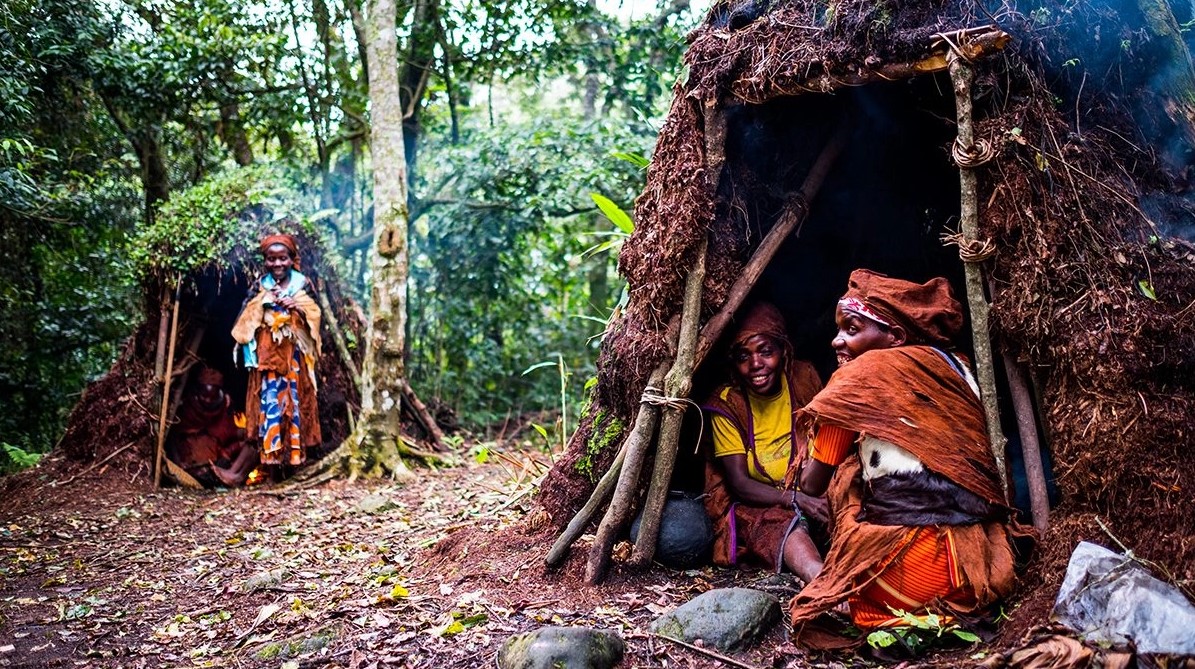
Batwa pygmies in Semuliki National Park: The park is one of the national parks in Uganda where the Batwa pygmies once lived. Semuliki National Park is located in the western part of Uganda in the Bundibugyo district, having a total area of 220 sq. km. Batwa pygmies once lived in the small national park, along with park wildlife.
Prior to the government’s 1993 decision to designate the region as a national park, Batwa pygmies resided in Semuliki National Park their entire lives. The Batwa were forced to leave the Semuliki forest and relocate to the surrounding areas. The Uganda Wildlife Authority took this move to liberate the animals and safeguard other park attractions.
The Batwa pygmies moved to the neighborhood of the national park after leaving the forest, and today visitors can see them in two communities. In Semuliki National Park, visitors can encounter the Batwa pygmies in Ntandi and Boma villages. While some have intermarried with other people, others have attempted to preserve their culture.
You can visit the homes of the Batwa pygmies by taking a cultural tour to Ntandi or Boma village. The person that takes you to various Batwa homes where you can engage with the residents and serves as a translator is their guide.
When you visit the Batwa, you can participate in a variety of community events. If visitors like to sample African cuisine, they can cook and eat lunch or dinner with the Batwa. In order to learn how various herbs are used as indigenous medicine, tourists can visit traditional healers.
One opportunity to learn about the history of the town is to visit the elderly guys. These seniors share tales of their time spent living among animals in the jungle. They describe the various foods they used to consume, the herbs they utilized, and the methods they employed to hunt various animals for flesh. At the end of the trip, travelers are always entertained by traditional dancers who perform drama and dance.
How much does it cost to see the Batwa pygmies?
Tourists must pay a specific amount of money in order to visit the Batwa pygmies in Semuliki National Park. The Batwa communities receive this funding in order to enhance their standard of living and invest in their small enterprises. Foreign and non-foreign residents pay $10 to see the Batwa Pygmies, while inhabitants of East African member nations pay UGX 10,000.
Other things to see in Semuliki national park
Various Species of Birds
The majority of the 435 bird species that call Semuliki National Park home can be seen by visitors during a birdwatching excursion. 23 of these bird species are reportedly unique to the Albertine region and are not found anyplace else in the nation. If visitors utilize reliable birding guides, they can view a variety of bird species in addition to the Batwa pygmies.
Shoe bill stork, Ross’s Turaco, Blue-billed malimbe, White-crested hornbill, Black-dwarf hornbill, Orange Cheeked waxbill, Lyre-tailed honeyguide, Spot-breasted Ibis, Yellow-throated cuckoo, Long-tailed hawk, Rufous-sided broadbill, White-throated Blue Swallow, Northern bearded scrub robin, and Crested Malimbe are among the birds found in Semuliki National Park.
The following are additional bird species: Orange-cheeked Waxbill, Black-Dwarf Hornbill, Lemon-bellied Crombec, Capuchin babbler, Forbe’s plover, Leaf-love, Zenker’s honeyguide, Red-bellied Malimbe, Long-tailed Hawk, Sassi’s olive greenbul, Purple-breasted sunbird, Nkulengu rail, Northern bearded scrub robin, Chestnut-breasted Negrofinch, Yellow-throated nicator, Red-thighed Sparrow hawk, and Forbe’s olive greenbul.
Butterflies
Because it has the most butterflies in the entire nation, Semuliki National Park is a well-known destination for butterflies. While strolling through the national park, visitors can observe 448 different species of butterflies. If visitors give butterfly gazing in Semuliki National Park enough time, they will be able to observe over half of the species that have been documented.
Peneleos Acraea, hill bush brown, choroclanis virescens, euphaedra hollandi, euphaedra edwardsii, cymothoe confusa, andriasa contraria, violet banded palla, common glider, veined swordtail, savanna pathfinder, euphaedra eberti, euphaedra alacris, forest glade nymph, soldier commodore, Becker’s creamy yellow glider, and euphaedra rattrayi are among the butterflies that can be found at Semuliki National Ark.
To name a few, these include: toothed stately bush brown, rhipidarctia crameri, common palm forester, euriphene saphirina, zebra pyrale, common nephele, cadarena pudoraria, coffee berry moth, boisduval’s tree nymph, marcipalina umbrosa, neuroxena ansorgei, variegated pearl, amata marina, haritalodes polycymalis, marcipalina conjuncta, orange streak Acraea, sarothroceras banaka, and chiasmia fulvisparsa.
Hot springs
Two host springs, known as the female and the male, are located within Semuliki National Park. Visitors are free to visit any or both of the hot springs, but the most popular is the female one, which has a geyser that shoots water up to two meters into the air. The water at the female hot spring may even boil eggs since it is so hot—more than 100 degrees Celsius. Though not as hot as the one in the female hot spring, the male hot spring is merely a pool of hot water.
What time of year is best to visit Semuliki National Park?
Semuliki National Park is open to visitors throughout the year, although the best time to visit semuliki during the dry season. The majority of park activities are favored by the dry season, which lasts from June to September and December to February. It is distinguished by low rainfall and an abundance of sunshine. During the dry season, the foliage is short with good vistas of wildlife, and the roads leading to the park are passable.
During the rainy season, when the lodges are offering discounts, tourists, particularly those on a tight budget, can visit Semuliki National Park. The park receives a lot of rainfall during the rainy season, which runs from March to May and October to November. A small number of visitors come to the park since the rain causes the walking paths to become muddy and slick, and the overgrown foliage obscures the animals’ views.
Getting to Semuliki to see the Pygmies of Batwa
Using road transportation, visitors can reach Semuliki National Park to see the Batwa pygmies. Due to its affordability, road transportation is the most popular form of transportation for visitors to Semuliki National Park. From Kampala, tourists go through Mityana, Mubende, Kyegegwa, Kyenjojo, Fort Portal, and lastly Bundibugyo, where the park is located. Travelers who arrive in Semuliki National Park by car always enjoy breathtaking views of the various landmarks along the route.