Location of Queen Elizabeth National Park: The western region of Uganda, which includes the districts of Rukungiri, Kasese, Kamwenge, and Rubirizi, is home to Queen Elizabeth National Park. With a total area of 1978 square kilometers of savannah, forest, and riverine vegetation cover, it is the second largest national park in the nation.
Queen Elizabeth National Park is roughly 400 kilometers southwest of Kampala, the country’s capital, and 265 kilometers from Entebbe International Airport. Travelers can drive from Kampala to the park in 7-8 hours, but flying takes 1 hour and 15 minutes.
The primary towns in the park’s north and south are Kasese and Rubirizi, respectively. The Kazinga Channel flows through the park, which is situated east of Lake Edward and west of Lake George.
Queen Elizabeth National Park stretches to the east to Kyambura Game Reserve, which is home to endangered chimpanzees, and to the south to Kigezi Wildlife Reserve, which is home to Maramagambo Forest. The northwest is home to Rwenzori Mountains National Park; the northeast is home to Kibale National Park; the west is home to Virunga National Park; and the south is home to Bwindi Impenetrable Forest National Park.
Location of Queen Elizabeth National Park
Getting to Queen Elizabeth National Park
Travelers can use air or ground transportation to get to the Park. It takes 708 hours to go by road from Kampala/Entebbe to Kasese, passing through Masaka, Mbarara, and Bushenyi before entering the park via the southern section. The northern part of the park can be reached via the alternative road, which passes through Mubende, Kyenjojo, Fort Portal, and Kasese.
By traveling through Kihihi and Kanungu to the park’s Ishasha section, visitors from Bwindi, particularly those from the Buhoma region, can reach the park in two to three hours. The road transportation ride to the park offers breathtaking views of the neighboring landmarks, plantations, and lovely people.
Queen Elizabeth National Park is accessible by plane for luxury travelers or those who detest long-distance travel. Every day, several airlines, including Bar Aviation Uganda and Aero Link Uganda, operate flights to the park. To avoid last-minute booking disappointments, you must have made reservations with the airline firm three to four months in advance if you want to travel to the Park.
Flights to Queen Elizabeth National Park depart from Entebbe International Airport or Kajjansi Airport and arrive at either Kasese Airport outside the park or Mweya Airport to the west of the park. Drivers are always available to take you from the airport to your reserved lodging. Every day, there are three flights to the Park: morning, midmorning, and afternoon.
Attractions in Queen Elizabeth National Park
Mammals
10 primate species and ninety-five animal species can be found at the Park, where they can find food and shelter in the savanna, woodland, and riverine vegetation. Chimpanzees can be observed at Kyambura Gorge, and game drives and boat cruises on Kazinga Channel are the finest ways to see the park’s species.
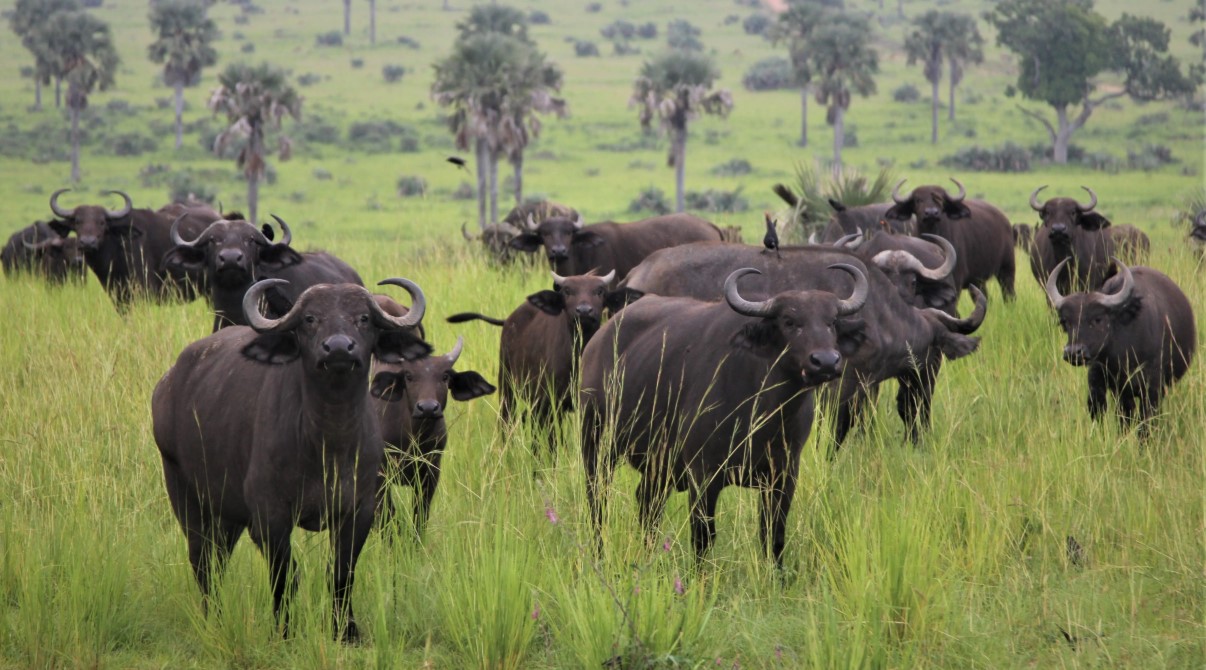
Lions, Sitatungas, elephants, topis, defassa waterbucks, buffaloes, bushbucks, spotted hyenas, bush babies, aardvarks, Nile crocodiles, hippos, giant forest hogs, small spotted genets, serval cats, Uganda kobs, banded mongoose, side-stripped jackals, and many other animals can be found in the Park.
Chimpanzees, red-tailed monkeys, blue monkeys, grey-checked mangabeys, black and white colobus monkeys, pattas monkeys, and olive baboons are among the primates found in Queen Elizabeth National Park. Chimpanzee hiking and nature hikes are the greatest ways to see them in the Kyambura Gorge area.
Bird Species
In Ishasha, Katwe, Katunguru bridge, Mweya peninsula, Maramagambo woodland, Kisenyi, and Lake Kikongoro regions of Queen Elizabeth National Park, more than 600 bird species have been identified. These birds can be observed on nature walks, game drives, and boat cruises. This park, which is regarded as one of the top birding locations in the nation, has drawn many bird enthusiasts.
Blue quill angler, African olive pigeon, great crested grebe, Africa pygmy goose, common waxbill, village indigo bird, shoebill stork, mottled spine-tailed swift, black cuckoo, white shrike flycatcher, African darter, African sacred ibis, dusky long-tailed cuckoo, African spoonbill, grey crowned crane, Ross’s turaco, Senegal thick-knee, blackcap puff back, and spur-winged lapwing are among the birds found in the Park.
Other notable bird species of Queen Elizabeth National Park include the African jacana, brown-capped weaver, common greenshank, African harrier hawk, brown snake eagle, lappet-faced vulture, martial eagle, cassin’s hawk-eagle, African fish eagle, yellow-mantled weaver, blue-throated brown bird, African grey hornbill, common scimitar bill, buff-spotted woodpecker, African thrush, cut-throat finch, grey-throated barbet, and olive bee-eater.
Water bodies
Lake George, Lake Edward, and the Kazinga Channel that connects them are the three bodies of water found in Queen Elizabeth National Park. The most popular activities are boat trips, which take place on the Kazinga Channel for two to three hours and allow visitors to see the park, water bodies, and many attractions like hippos, crocodiles, birds, and park animals.
Best time to visit Queen Elizabeth National Park
Although Queen Elizabeth National Park is open year-round, some times of the year are better than others. The best time to visit Queen Elizabeth National Park is during the dry season, which runs from June to September and December to February. It is marked by little to no rainfall, which leaves game trails and trails dry, short, thin vegetation that obscures views of the attractions, and always passable roads leading to the park.
In order to take advantage of discounted lodging options, visitors, particularly those on a tight budget, can visit Queen Elizabeth National Park during the rainy seasons of March through May and October through November. Travelers should be aware that during the rainy season, roads leading to the park become impassable, game vehicles and trails get muddy and slick, and the vegetation is always tall, making it difficult to see the animals.